Do I Have ADHD as an Adult?12 Signs You Should Not Ignore
Many adults struggle with focus, procrastination, or mental overload without realizing ADHD may be the underlying cause. Learn the 12 common signs of adult ADHD and when to consider a professional evaluation.
Many adults spend years believing they are simply disorganized, unmotivated, or easily distracted.
However, for many people, these experiences are actually related to Attention-Deficit/Hyperactivity Disorder (ADHD).
ADHD is often associated with childhood, but research shows that many individuals reach adulthood without ever receiving an evaluation or diagnosis. As responsibilities increase—careers, finances, relationships, and family life—symptoms may become more noticeable.
If you’ve ever wondered whether ADHD might explain ongoing struggles with focus, organization, or productivity, understanding the common signs can be an important first step.
Adults located in Pennsylvania and Delaware who want to understand the process can learn more about the structured evaluation process here.
Why ADHD Often Goes Undiagnosed in Adults
Many adults with ADHD performed reasonably well in school or developed coping strategies that masked symptoms.
For example, someone might have relied on:
• working extremely long hours
• using constant reminders and alarms
• depending on last-minute pressure to complete tasks
These strategies can work temporarily. However, as life becomes more complex, these coping mechanisms may stop working as effectively.
This is often when adults begin asking whether ADHD could be contributing to ongoing challenges.
12 Signs of ADHD in Adults
While ADHD affects people differently, there are several patterns that frequently appear in adults.
1. Difficulty Starting Tasks
Many adults with ADHD describe knowing exactly what needs to be done but struggling to begin the task.
This is sometimes referred to as task initiation difficulty, which is related to executive function.
2. Chronic Procrastination
Procrastination with ADHD often has less to do with laziness and more to do with how the brain regulates motivation and attention.
3. Difficulty Maintaining Focus
Adults with ADHD may struggle to stay focused during long meetings, reading tasks, or detailed projects.
4. Forgetfulness
Missing appointments, forgetting deadlines, or misplacing important items are common experiences.
5. Feeling Mentally Overwhelmed
Managing multiple responsibilities simultaneously can feel mentally exhausting.
6. Trouble Organizing Tasks
Many adults with ADHD report difficulty prioritizing tasks and organizing complex projects.
7. Frequently Losing Items
Keys, phones, wallets, and documents often seem to disappear.
8. Difficulty Following Through on Projects
Starting projects with enthusiasm but struggling to complete them is a common pattern.
9. Restlessness
Adults with ADHD may feel internally restless or mentally “on edge.”
10. Racing Thoughts
The mind may jump rapidly between ideas, making it difficult to maintain sustained attention.
11. Difficulty Managing Time
Deadlines can feel distant until they suddenly become urgent.
12. Burnout from Constant Effort
Many adults with ADHD work significantly harder than others just to maintain organization and productivity.
Over time, this can lead to ADHD-related burnout.
How ADHD Is Evaluated in Adults
An ADHD diagnosis involves a structured clinical evaluation that examines:
• childhood history of symptoms
• current functional challenges
• executive functioning patterns
• possible overlapping conditions
Adults interested in ADHD testing can learn more about how the process works here.
Testing helps support the diagnostic process, while the clinical evaluation ensures the diagnosis is accurate.
When to Consider an ADHD Evaluation
If ADHD symptoms are interfering with work, school, or daily functioning, a professional evaluation may help clarify whether ADHD is contributing to these difficulties.
Adults located in Pennsylvania and Delaware can schedule an ADHD consultation through ADHD Philadelphia.
In-person appointments may be available after the initial telehealth appointment when clinically appropriate. Walk-in appointments are not available.
Final Thoughts
Many adults spend years wondering why focus, organization, or productivity feels harder than it should.
Understanding ADHD and receiving an appropriate evaluation can provide clarity and help guide treatment options when appropriate.
Educational content such as this can help individuals better understand the symptoms and evaluation process for ADHD.
Adult ADHD Burnout: Why High-Functioning Adults Eventually Hit a Wall
Adult ADHD burnout is common among high-functioning professionals who have spent years compensating for attention difficulties. Learn how ADHD evaluations work for adults in Pennsylvania and Delaware and how diagnosis and treatment can help restore focus and productivity.
Many adults with ADHD spend years pushing themselves to keep up with responsibilities at work, school, and home. They develop systems, reminders, and coping strategies to stay organized and productive.
From the outside, they may appear successful and high-functioning.
But internally, many adults with ADHD experience a constant mental effort just to maintain focus, complete tasks, and manage daily responsibilities.
Over time, this effort can lead to something many adults describe as ADHD burnout.
For individuals who have lived for years without understanding their symptoms, burnout can feel confusing and overwhelming.
Understanding how ADHD burnout develops is often the first step toward finding effective support and treatment.
What ADHD Burnout Looks Like in Adults
ADHD burnout is not simply feeling tired from a busy week.
It often develops after years of managing attention difficulties without proper support or diagnosis.
Adults experiencing ADHD burnout may notice:
• Difficulty starting tasks they previously managed
• Feeling mentally exhausted even after small responsibilities
• Increased procrastination
• Emotional frustration with themselves
• Trouble organizing thoughts or priorities
• Reduced motivation despite wanting to succeed
Many adults describe feeling as though their brain has simply “hit a wall.”
In reality, ADHD burnout is often the result of long-term cognitive overload.
If these experiences sound familiar, learning more about the Adult ADHD diagnosis process in Pennsylvania and Delaware can help clarify whether ADHD may be contributing to these patterns.
Why High-Functioning Adults Often Go Undiagnosed
Many adults with ADHD performed reasonably well in school and early career environments.
Because of this, teachers, parents, and employers may never have suspected ADHD.
Instead, these individuals often relied on:
• Working longer hours than others
• Using intense effort to stay organized
• Constant reminders and lists
• Last-minute deadline pressure to trigger productivity
While these strategies can work temporarily, they often become unsustainable as responsibilities increase.
Career demands, family responsibilities, financial stress, and complex schedules can make ADHD symptoms more noticeable.
This is why many adults seek an ADHD evaluation later in life, sometimes in their 30s, 40s, or even 50s.
If you are wondering whether ADHD may be affecting your attention or productivity, you can learn more about ADHD testing and evaluation for adults in Pennsylvania and Delaware.
How ADHD Evaluations Help Adults Move Forward
An ADHD evaluation helps determine whether attention difficulties are related to ADHD or another condition affecting focus and executive functioning.
At ADHD Philadelphia, the evaluation process is designed to be structured, transparent, and accessible for adults.
The evaluation generally includes two steps.
ADHD Consultation
The first step is a clinical consultation conducted through secure telehealth.
During this visit we discuss:
• Current attention and focus concerns
• Childhood ADHD symptom history
• Work and daily functioning
• Medical and mental health history
• Screening for other conditions that can affect attention
Consultation cost: $150
ADHD Testing
When appropriate, structured ADHD testing may be recommended.
This may include evidence-based questionnaires and computerized testing designed to support the diagnostic process.
Testing cost: $150
Total evaluation cost: $300
This transparent structure allows adults to receive a thorough evaluation without the extremely high costs sometimes associated with large neuropsychological testing programs.
ADHD Treatment After Diagnosis
If ADHD is diagnosed, treatment options may include:
• ADHD medication management
• Executive functioning strategies
• Behavioral approaches for attention regulation
• Lifestyle strategies to support productivity and focus
Medication is not required for every patient, but when appropriate it can significantly improve attention regulation and daily functioning.
Learn more about ADHD treatment and medication management for adults in Pennsylvania and Delaware here:
Telehealth ADHD Evaluations in Pennsylvania and Delaware
Many adults prefer telehealth evaluations because they allow them to complete their consultation from home.
At ADHD Philadelphia, telehealth ADHD consultations are available for adults located in:
• Pennsylvania
• Delaware
In-person appointments may be scheduled after the first telehealth appointment when clinically appropriate.
When to Consider an ADHD Evaluation
Adults often consider ADHD testing when they notice patterns such as:
• Difficulty focusing at work
• Struggling to complete projects
• Feeling mentally scattered or overwhelmed
• Chronic procrastination
• Difficulty transitioning between tasks
An ADHD evaluation can help determine whether ADHD may be contributing to these challenges and whether treatment options may help improve daily functioning.
Schedule an ADHD Evaluation
If you live in Pennsylvania or Delaware and believe ADHD may be affecting your focus, productivity, or daily functioning, an evaluation may be the next step.
Appointments are available through secure telehealth.
Book an ADHD consultation here: Same-day appointment.

How Much Does ADHD Testing Cost for Adults? A Transparent Guide for Pennsylvania and Delaware
Many adults wonder how much ADHD testing costs and what the evaluation process involves. This guide explains typical ADHD testing costs for adults and how structured ADHD evaluation works in Pennsylvania and Delaware.
Many adults struggle with focus, organization, procrastination, and mental overwhelm without realizing that Attention-Deficit/Hyperactivity Disorder (ADHD) may be part of the reason. While ADHD is often associated with childhood, research shows that millions of adults continue to experience ADHD symptoms throughout their lives.
As awareness of adult ADHD grows, more people are searching for answers and considering an evaluation. One of the most common questions people ask before scheduling an appointment is:
“How much does ADHD testing cost?”
The answer can vary widely depending on the provider, the type of evaluation performed, and whether insurance is used. This guide explains what ADHD testing typically costs and what adults in Pennsylvania and Delaware can expect when seeking an ADHD evaluation.
Many adults begin exploring an ADHD evaluation for adults after struggling with focus, productivity, or organization for years.
Why Adults Seek ADHD Testing
Many adults reach a point where they begin to question whether ADHD could explain lifelong challenges with attention, productivity, or organization. For some individuals, the signs were present in childhood but were never formally evaluated.
Others begin noticing symptoms when work demands increase, when they return to school, or when managing responsibilities such as career, family, and finances becomes overwhelming.
Common reasons adults seek ADHD testing include:
Difficulty focusing at work or school
Chronic procrastination or trouble starting tasks
Forgetfulness and losing important items
Difficulty managing time or deadlines
Mental fatigue from trying to stay organized
Impulsive decisions or difficulty regulating attention
Some adults have developed coping strategies that helped them succeed academically or professionally, but these strategies often become harder to maintain as life responsibilities increase.
An ADHD evaluation can help determine whether these patterns are related to ADHD or another condition that affects attention and executive functioning.
How Much ADHD Testing Typically Costs
Across the United States, ADHD evaluations for adults can vary significantly in cost.
Some comprehensive psychological testing programs may cost $800 to $3,000 or more, particularly when extensive neuropsychological testing is involved.
These evaluations often include multiple hours of testing, scoring, and interpretation. While comprehensive testing may be appropriate in some cases, it is not always necessary for diagnosing ADHD in adults.
Other factors that influence cost include:
Whether testing is performed by a psychologist, psychiatrist, or psychiatric nurse practitioner
The length of the evaluation process
Whether computerized testing or rating scales are used
Whether insurance covers the evaluation
In many healthcare systems, adults may also encounter long waitlists, sometimes waiting months before an appointment becomes available.
Because of these factors, many adults delay evaluation even when ADHD symptoms are significantly affecting their daily lives.
How ADHD Testing Works at ADHD Philadelphia
At ADHD Philadelphia, the evaluation process is designed to be structured, transparent, and accessible for adults seeking answers about ADHD.
The evaluation typically includes two parts.
ADHD Consultation
The first step is a clinical consultation conducted through secure telehealth. During this appointment, we discuss:
Current symptoms affecting focus and attention
Childhood history of ADHD symptoms
Work, academic, and daily functioning
Medical and mental health history
Screening for other conditions that can affect attention
This consultation allows us to determine whether ADHD testing is appropriate and helps ensure the evaluation is accurate and clinically meaningful.
Consultation cost: $150
ADHD Testing
When appropriate, structured ADHD testing may be recommended. Testing can include evidence-based screening tools and questionnaires that help assess attention, executive functioning, and symptom patterns consistent with ADHD.
These tools help support the diagnostic process and provide additional information about how attention and cognitive functioning may be affected.
ADHD testing cost: $150
Total Initial Evaluation Cost
For adults completing both steps, the total cost of the ADHD evaluation is $300.
This structured approach allows adults to receive a thorough ADHD assessment while maintaining clear and transparent pricing.
A structured evaluation helps ensure an accurate adult ADHD diagnosis and rules out other causes of attention difficulties.
Why Accurate ADHD Diagnosis Matters
Receiving an accurate ADHD diagnosis can be an important turning point for many adults.
For individuals who have spent years feeling frustrated by focus or productivity challenges, understanding the underlying cause can bring clarity and direction.
An accurate diagnosis allows individuals to:
Understand how ADHD affects attention and executive functioning
Explore treatment options that may improve daily functioning
Develop strategies for managing time, focus, and organization
Improve work performance or academic productivity
Reduce frustration related to symptoms that previously felt unexplained
For many adults, simply understanding how ADHD affects their brain can help reduce self-criticism and open the door to more effective strategies.
ADHD Treatment Options After Diagnosis
After an ADHD diagnosis is confirmed, treatment may include several approaches depending on the individual's needs and medical history.
Common treatment options include:
ADHD medication management
Behavioral strategies for attention and organization
Executive functioning support
Lifestyle strategies that support focus and productivity
Medication is not always required, but when appropriate, it can significantly improve attention regulation for many individuals with ADHD.
After diagnosis, many adults explore ADHD treatment and medication management to improve focus and daily functioning.
At ADHD Philadelphia, treatment plans are developed collaboratively and are tailored to each individual's symptoms and goals.
Telehealth ADHD Evaluations in Pennsylvania and Delaware
Many adults prefer telehealth evaluations because they allow individuals to complete an ADHD consultation from home without traveling to an office.
At ADHD Philadelphia, telehealth appointments are available for adults located in:
Pennsylvania
Delaware
Telehealth can make ADHD evaluation more accessible for adults with busy work schedules, family responsibilities, or transportation limitations.
In some cases, in-person appointments may be scheduled after the first telehealth evaluation when clinically appropriate.
When Should Adults Consider ADHD Testing?
If you frequently experience difficulty with attention, organization, or task completion, it may be helpful to consider an ADHD evaluation.
Adults often seek testing when they notice patterns such as:
Struggling to stay focused at work
Difficulty finishing projects or assignments
Feeling mentally scattered or overwhelmed
Constantly needing reminders or lists to stay organized
Difficulty transitioning between tasks
An ADHD evaluation can help determine whether ADHD may be contributing to these challenges and whether treatment options may be beneficial.
Scheduling an ADHD Evaluation
If you live in Pennsylvania or Delaware and believe ADHD may be affecting your daily functioning, scheduling an evaluation can be an important first step.
At ADHD Philadelphia, appointments are available through secure telehealth, allowing adults to begin the evaluation process from home.
You can learn more about the ADHD evaluation process or schedule an appointment online.
If you live in Pennsylvania or Delaware and believe ADHD may be affecting your life, you can book an ADHD evaluation online.

How Adults Get Tested for ADHD: What to Expect During an ADHD Evaluation
Many adults wonder whether ADHD may explain their difficulties with focus and organization. Learn how ADHD testing works and what to expect during an evaluation.
Many adults begin researching ADHD after years of struggling with focus, procrastination, or mental overload.
While ADHD is often associated with childhood, many individuals are not diagnosed until adulthood. In some cases, people developed coping strategies that masked symptoms earlier in life. As responsibilities increase with work, family, and daily responsibilities, ADHD symptoms may become more noticeable.
Adults across Pennsylvania and Delaware frequently seek professional evaluation after wondering for years why everyday tasks feel unusually difficult.
Understanding how ADHD testing works can help individuals decide whether an evaluation may be helpful.
If you are unsure whether ADHD may be affecting you, you may also find our article helpful on 7 Signs You May Have Undiagnosed ADHD as an Adult.
Step 1: Initial ADHD Consultation
The first step in an ADHD evaluation typically involves a comprehensive clinical consultation.
During this appointment, the clinician gathers detailed information about the individual’s history, including:
• current symptoms affecting focus and organization
• childhood patterns of attention and behavior
• work and academic experiences
• daily functioning and responsibilities
• possible co-occurring conditions such as anxiety or depression
The purpose of this consultation is to understand how attention difficulties may be affecting different areas of life.
Step 2: Reviewing Symptom Patterns
Clinicians evaluate whether symptoms are consistent with the diagnostic criteria used to identify ADHD.
This includes examining patterns such as:
• difficulty maintaining attention
• chronic procrastination
• forgetfulness
• difficulty organizing tasks
• impulsivity or restlessness
A key part of this process involves determining whether symptoms have been present for many years and whether they occur in multiple settings.
Many adults recognize these patterns after reading about what ADHD feels like for adults who were never diagnosed.
Step 3: ADHD Screening and Assessment Tools
In some cases, clinicians may use standardized ADHD screening tools or computerized assessments.
These tools can help evaluate areas such as:
• attention consistency
• response speed
• working memory
• executive functioning
Screening tools do not replace a professional evaluation, but they can provide additional data to support the assessment process.
Step 4: Ruling Out Other Possible Causes
Another important part of an ADHD evaluation is determining whether symptoms may be explained by other conditions.
Several experiences can resemble ADHD symptoms, including:
• anxiety
• depression
• chronic stress
• sleep difficulties
This is why professional evaluation is important. Symptoms that appear similar may have different underlying causes.
You can learn more about this in our article ADHD vs Anxiety: How Adults Can Tell the Difference.
Step 5: Determining Whether ADHD Is Present
After reviewing the individual’s history, symptom patterns, and assessment results, the clinician determines whether ADHD criteria are met.
If ADHD is diagnosed, the next step involves discussing treatment options.
Treatment may include:
• ADHD medication when appropriate
• behavioral strategies for focus and organization
• coaching or therapy approaches that support executive functioning
ADHD Evaluation and Treatment in Pennsylvania and Delaware
At ADHDPhiladelphia.com, adults can receive professional ADHD evaluations and treatment through secure telehealth appointments.
Our evaluation process focuses on helping individuals understand their symptoms and explore treatment options that support focus, productivity, and daily functioning.
Many adults report feeling a sense of relief when they finally understand why attention and organization have felt difficult for so many years.
If you have been wondering whether ADHD may be affecting your daily life, a professional evaluation may help provide clarity.
Learn more about Adult ADHD Testing and Evaluation at ADHDPhiladelphia.com.
If you are struggling with focus, organization, or motivation, you can book an ADHD evaluation online here.
Related ADHD Resources

What ADHD Feels Like for Adults Who Were Never Diagnosed
Many adults struggle with focus, procrastination, or mental overload without realizing ADHD may be the cause. Learn what ADHD feels like for adults and when an evaluation may help.
Many adults live for years feeling overwhelmed, distracted, or mentally exhausted without realizing that ADHD may be the underlying cause.
Attention-Deficit/Hyperactivity Disorder is often associated with childhood, but many individuals are not diagnosed until adulthood. Some adults performed well academically or developed coping strategies that masked symptoms earlier in life.
However, as responsibilities increase with work, family, finances, and daily life, the challenges associated with ADHD can become more noticeable.
Adults across Pennsylvania and Delaware frequently begin researching ADHD after years of wondering why everyday tasks feel unusually difficult.
Understanding what ADHD feels like for adults can help individuals recognize patterns and determine whether an evaluation may be helpful.
If you have not yet read it, you may also find our article helpful on 7 Signs You May Have Undiagnosed ADHD as an Adult.
1. Constant Mental Noise
Many adults with ADHD describe a constant stream of thoughts.
Instead of a calm mental environment, the brain may feel like several conversations happening at once. This can make it difficult to concentrate on a single task, especially tasks that require sustained attention.
Some individuals describe this experience as:
• difficulty focusing during meetings
• losing track of conversations
• jumping between ideas or tasks
These experiences are often related to differences in the brain’s attention regulation system, which plays a role in maintaining focus and filtering distractions.
2. Difficulty Starting Tasks
One of the most frustrating experiences reported by adults with ADHD is difficulty starting tasks, even when the task is important.
This is sometimes called task paralysis.
Examples include:
• staring at an email but delaying the response
• postponing a work assignment until the deadline approaches
• feeling overwhelmed when beginning a large project
These challenges are related to executive functioning processes in the brain, which help with planning, organizing, and initiating actions.
3. Feeling Overwhelmed by Routine Responsibilities
Many adults with ADHD feel mentally overwhelmed by everyday tasks that seem manageable for others.
This may include:
• organizing schedules
• managing paperwork
• planning daily responsibilities
This sense of mental overload can lead to frustration, fatigue, or avoidance of certain tasks.
4. Productivity That Comes in Bursts
Adults with ADHD often experience productivity in cycles.
There may be periods of intense focus and productivity followed by periods of difficulty concentrating or completing tasks.
Some individuals describe this pattern as:
• hyper-focus on interesting activities
• difficulty sustaining effort on repetitive tasks
• last-minute bursts of productivity before deadlines
These patterns can make work performance feel inconsistent.
5. Forgetfulness and Disorganization
Another common experience is frequent forgetfulness.
Examples include:
• misplacing keys or phones
• forgetting appointments
• overlooking details in work tasks
These patterns can sometimes be mistaken for carelessness when they are actually related to attention regulation and working memory.
6. Restlessness or Difficulty Relaxing
While hyperactivity is often associated with childhood ADHD, adults may experience restlessness differently.
This may appear as:
• difficulty sitting through long meetings
• feeling mentally restless
• constantly seeking stimulation or activity
Many adults describe feeling like their brain is always “on.”
7. Realizing These Patterns Have Been Present for Years
During ADHD evaluations, clinicians often explore whether symptoms have been present since childhood.
Adults frequently recall experiences such as:
• struggling with organization in school
• difficulty completing assignments
• needing extra time to study or finish tasks
These patterns may not have been recognized as ADHD earlier in life.
When It May Be Helpful to Consider an ADHD Evaluation
If these patterns have been persistent and interfere with work, relationships, or daily responsibilities, it may be helpful to consider an ADHD evaluation.
Many adults initially believe their symptoms are caused by stress, anxiety, or lack of discipline.
However, ADHD and anxiety can sometimes appear similar.
You can learn more about this in our article ADHD vs Anxiety: How Adults Can Tell the Difference.
A professional evaluation can help determine whether ADHD, anxiety, or another condition may be contributing to these experiences.
ADHD Evaluation and Treatment in Pennsylvania and Delaware
At ADHDPhiladelphia.com, adults can receive professional ADHD evaluations and treatment through secure telehealth appointments.
Our goal is to help individuals better understand their symptoms and explore treatment options that support focus, organization, and overall functioning.
If you have been struggling with attention, motivation, or mental overload, an evaluation may help provide clarity.
Learn more about Adult ADHD Testing and Evaluation at ADHDPhiladelphia.com.

7 Signs You May Have Undiagnosed ADHD as an Adult (and When to Seek an Evaluation)
Many adults struggle with focus, motivation, and organization without realizing ADHD may be the cause. Learn the common signs of undiagnosed ADHD in adults and when an evaluation may help.
Many adults struggle with focus, procrastination, or mental overload without realizing ADHD may be the underlying cause.
While ADHD is often associated with childhood, many people are not diagnosed until adulthood. In some cases, individuals may have performed well academically or developed coping strategies that masked symptoms earlier in life.
However, as responsibilities increase with work, relationships, and daily life, the challenges associated with ADHD can become more noticeable.
Adults across Pennsylvania and Delaware frequently seek evaluations after years of wondering why tasks that seem manageable for others feel unusually difficult.
Understanding the signs of adult ADHD can help determine whether an evaluation may be helpful.
Adults who recognize these patterns often begin by learning more about Adult ADHD testing and diagnosis.
1. Chronic Difficulty Maintaining Focus
Adults with ADHD often describe difficulty maintaining attention during tasks that require sustained concentration.
Common examples include:
• difficulty finishing work projects
• losing track of conversations
• frequently switching tasks before completing them
Many individuals report feeling mentally scattered even when they are motivated to complete their responsibilities.
2. Persistent Procrastination
Procrastination is common, but ADHD-related procrastination often feels different.
Adults with ADHD may:
• delay starting tasks even when they know the task is important
• struggle with time management
• feel overwhelmed when facing large projects
This pattern can affect work performance and daily functioning.
3. Feeling Mentally Overwhelmed by Routine Tasks
Simple responsibilities such as organizing paperwork, responding to emails, or planning schedules can feel disproportionately difficult.
Many adults with ADHD describe experiencing:
• mental clutter
• difficulty prioritizing tasks
• trouble deciding where to begin
This is often related to challenges with executive functioning, which affects planning, organization, and task initiation. Executive function differences are a core part of ADHD and can make everyday responsibilities feel overwhelming.
4. Frequent Forgetfulness
Adults with ADHD may frequently:
• forget appointments
• misplace important items
• overlook details in work tasks
These patterns can sometimes be mistaken for carelessness, when in reality they may be related to attention regulation.
5. Difficulty Staying Organized
Organization challenges are one of the most common concerns reported by adults with ADHD.
Examples may include:
• cluttered workspaces
• difficulty maintaining schedules
• struggling to keep track of multiple responsibilities
These difficulties often become more noticeable when work or family responsibilities increase.
6. Restlessness or Difficulty Relaxing
While hyperactivity is often associated with childhood ADHD, adults may experience restlessness in different ways.
This may include:
• feeling mentally “on edge”
• difficulty sitting through long meetings
• constantly needing stimulation or activity
7. Longstanding Patterns Since Childhood
One of the key indicators clinicians consider during an ADHD evaluation is whether symptoms have been present for many years.
Adults often recall:
• difficulty concentrating in school
• needing extra time for assignments
• struggling with organization or deadlines
These patterns may not have been recognized as ADHD earlier in life.
When to Consider an ADHD Evaluation
If these patterns have been persistent and interfere with work, relationships, or daily responsibilities, it may be helpful to consider an Adult ADHD evaluation.
Many adults initially believe their difficulties are related to stress or anxiety. In reality, ADHD and anxiety can sometimes appear similar.
You can learn more about this in our article on ADHD vs Anxiety: How Adults Can Tell the Difference.
A professional evaluation can help determine whether ADHD, anxiety, or another condition may be contributing to these experiences.
ADHD Evaluation and Treatment in Pennsylvania and Delaware
At ADHDPhiladelphia.com, adults can receive professional ADHD evaluation and treatment through secure telehealth appointments.
Our goal is to help individuals better understand their symptoms and explore appropriate treatment options that support focus, organization, and overall functioning.
Many adults in Philadelphia, Wilmington, and across Pennsylvania and Delaware seek ADHD evaluations after years of struggling with focus, organization, and motivation.

ADHD vs Anxiety in Adults: How to Tell the Difference (and Why It Matters)
Struggling to focus or feeling overwhelmed? Learn the key differences between ADHD and anxiety in adults and how to get the right diagnosis and treatment in Pennsylvania and Delaware.
ADHD vs Anxiety in Adults: How to Tell the Difference (and Why It Matters)
Many adults struggling with focus, racing thoughts, and feeling overwhelmed assume they have anxiety.
But what many don’t realize is this:
👉 ADHD and anxiety can look very similar—but they come from very different causes.
Understanding the difference is one of the most important steps toward getting the right treatment and finally feeling in control again.
🧠 WHY ADHD AND ANXIETY GET CONFUSED
Both ADHD and anxiety can cause:
Difficulty concentrating
Restlessness
Racing thoughts
Feeling overwhelmed
Trouble completing tasks
But here’s the key difference:
👉 ADHD is a regulation problem
👉 Anxiety is a fear-based response
ADHD affects executive functioning—your brain’s ability to organize, prioritize, and follow through.
Anxiety is driven by worry, stress, and anticipation of negative outcomes.
⚖️ KEY DIFFERENCES BETWEEN ADHD AND ANXIETY
🔹 ADHD (Attention-Deficit/Hyperactivity Disorder)
Lifelong pattern (often since childhood)
Difficulty starting and finishing tasks
Easily distracted—even without stress
Time blindness and procrastination
Forgetfulness and disorganization
Focus improves with interest or urgency
🔹 Anxiety
Driven by excessive worry or fear
Thoughts are often future-focused (“what if…”)
Avoidance of tasks due to fear of failure
Physical symptoms (tight chest, racing heart)
Overthinking and rumination
Focus improves when anxiety decreases
⚠️ WHEN BOTH HAPPEN TOGETHER
Many adults actually have both ADHD and anxiety.
In fact:
👉 Untreated ADHD often leads to anxiety over time.
Why?
Because repeated struggles with focus, deadlines, and organization can create chronic stress and self-doubt.
🧪 HOW TO KNOW WHAT YOU’RE DEALING WITH
Ask yourself:
Do I struggle even when I’m calm? → more likely ADHD
Do my symptoms get worse with stress? → more likely anxiety
Have I had these issues since childhood? → ADHD likely present
The most accurate way to know is through a professional ADHD evaluation for adults.
📍 ADHD TESTING AND TREATMENT IN PENNSYLVANIA & DELAWARE
At ADHDPhiladelphia.com, we specialize in helping adults who feel:
Overwhelmed
Unfocused
Misdiagnosed
Or unsure what’s really going on
We offer:
ADHD evaluations for adults
Personalized treatment plans
Telehealth appointments in PA & DE
👉 If you’ve been wondering whether it’s ADHD, anxiety, or both—this is your next step.
ADHD in Adults: Signs You Were Never Diagnosed (And What to Do Next)
Many adults struggle with focus, organization, and overwhelm without realizing ADHD may be the cause. Learn the key signs of undiagnosed adult ADHD and how to get evaluated in Pennsylvania and Delaware.
Many adults go years—sometimes decades—without realizing they have ADHD.
They may have learned to cope, push through, or compensate. But over time, the challenges often become harder to manage, especially with increased responsibilities, work demands, or life stress.
If you’ve ever wondered whether your struggles with focus, motivation, or organization could be something more, this guide can help you understand the signs of ADHD symptoms in adults and what steps to take next.
Why ADHD Often Goes Undiagnosed in Adults
ADHD is commonly associated with childhood, but many adults were never evaluated growing up.
Some individuals:
Performed well enough in school
Developed coping strategies early
Were misdiagnosed with anxiety or depression
As a result, adult ADHD diagnosis is often delayed until symptoms begin to interfere more significantly with work, relationships, or daily functioning.
Common Signs of Undiagnosed ADHD in Adults
1. Chronic Difficulty Starting Tasks
You may know exactly what needs to be done—but struggle to begin.
This is not procrastination in the traditional sense. It’s often related to executive function challenges in the brain.
2. Feeling Constantly Overwhelmed
Tasks pile up quickly, leading to mental overload.
If this sounds familiar, you may relate to our guide on
👉 Why Adults with ADHD Feel Overwhelmed and How to Regain Control
3. Trouble Staying Organized
You may frequently:
Lose important items
Forget appointments
Struggle to keep systems in place
4. Inconsistent Focus
Some days you’re highly productive.
Other days, even simple tasks feel impossible to complete.
5. Restlessness or Racing Thoughts
Many adults with ADHD describe:
Difficulty “turning off” their mind
Feeling mentally restless
Jumping between thoughts
This can sometimes be confused with anxiety.
ADHD vs Anxiety: Why the Difference Matters
ADHD and anxiety share overlapping symptoms—but they are not the same.
Understanding the difference is key to choosing the right treatment approach.
If you’re unsure which may apply to you, read:
👉 ADHD vs Anxiety: How Adults Can Tell the Difference
When to Consider an ADHD Evaluation
You may benefit from an evaluation if:
Symptoms have been present since childhood
You experience consistent difficulty with focus or organization
Your daily functioning is impacted at work or home
At ADHD Philadelphia, we provide adult ADHD diagnosis in Pennsylvania and Delaware, helping individuals better understand their symptoms and explore treatment options.
ADHD Testing and Treatment Options
If ADHD is identified, treatment can significantly improve daily functioning.
Options may include:
Behavioral strategies
Lifestyle adjustments
Medication management
Learn more about:
👉 ADHD Testing & Evaluation for Adults in Pennsylvania & Delaware
👉 ADHD Treatment & Medication Management for Adults in Pennsylvania & Delaware
Local ADHD Testing in Pennsylvania & Delaware
We provide ADHD evaluations for adults in:
Take the Next Step
If you’ve been struggling with focus, motivation, or feeling overwhelmed, it may be time to explore whether ADHD is the underlying cause.
ADHD is treatable—and understanding your symptoms is the first step toward regaining control.
👉 Book your evaluation at ADHDPhiladelphia.com

Why Adults With ADHD Feel Overwhelmed (And How to Regain Control)
Many adults feel overwhelmed but don’t realize ADHD may be the cause. Learn why ADHD affects focus, organization, and stress—and how treatment can help in Pennsylvania and Delaware.
Why Adults With ADHD Feel Overwhelmed (And How to Regain Control)
Many adults feel overwhelmed at times—but for individuals with ADHD, that feeling can be constant.
If you’ve ever felt like your brain has too many tabs open, struggled to start tasks, or found yourself mentally exhausted before the day even begins, you’re not alone.
For many adults, this isn’t just stress—it may be ADHD.
What Overwhelm Feels Like With ADHD
ADHD-related overwhelm often includes:
Difficulty starting tasks
Trouble prioritizing what matters most
Constant mental clutter
Feeling paralyzed by simple decisions
Chronic procrastination
Emotional frustration or shutdown
This isn’t a lack of motivation—it’s a difference in how the brain manages attention and executive function.
Why ADHD Causes Overwhelm
ADHD affects the brain’s executive functioning system, which is responsible for:
Planning
Organizing
Initiating tasks
Managing time
Regulating attention
When these systems are impaired, even small tasks can feel overwhelming.
Many adults describe it as:
“Knowing what to do—but not being able to do it.”
The Hidden Cycle of ADHD Overwhelm
Without treatment, ADHD overwhelm can create a cycle:
Tasks pile up
You feel overwhelmed
You avoid starting
Stress increases
Productivity drops
Guilt and frustration grow
This cycle repeats—and often worsens over time.
ADHD vs Stress: What’s the Difference?
While stress can cause temporary overwhelm, ADHD-related overwhelm is:
Persistent
Task-specific
Linked to focus and organization
Present across multiple areas of life
If this has been happening for years, ADHD may be worth evaluating.
How ADHD Treatment Helps Reduce Overwhelm
The good news is that ADHD is highly treatable.
Treatment may include:
Medication management
Behavioral strategies
Structure and routine development
Executive function support
Research shows that evidence-based treatments, including stimulant and non-stimulant medications, are among the most effective options for improving ADHD symptoms .
If you’re experiencing chronic focus problems, mental overload, or difficulty finishing tasks, it may help to understand whether ADHD or anxiety is the underlying cause. Our article on ADHD vs anxiety in adults explains the differences and when an evaluation may be helpful.
When to Consider an ADHD Evaluation
You may benefit from an evaluation if you:
Feel overwhelmed daily
Struggle to complete tasks
Have difficulty focusing or organizing
Experience ongoing procrastination
Notice these patterns affecting work or relationships
ADHD Testing in Pennsylvania & Delaware
If you're located in Pennsylvania or Delaware, ADHDPhiladelphia.com offers comprehensive evaluations and treatment for adults.
Explore ADHD testing options near you:
• Philadelphia: Adult ADHD Testing in Philadelphia
• Wilmington: Adult ADHD Testing in Wilmington
• Dover: ADHD Testing in Dover, DE
• Newark: Adult ADHD Testing in Newark, DE
• Pittsburgh: Adult ADHD Testing in Pittsburgh, PA
• Harrisburg: Adult ADHD Testing in Harrisburg, PA
• Allentown: Adult ADHD Testing in Allentown, PA
You can also learn more about ADHD diagnosis and treatment here:
Take the First Step
You don’t have to keep feeling overwhelmed.
With the right diagnosis and treatment plan, many adults experience significant improvements in focus, clarity, and daily functioning.
👉 Book your ADHD evaluation today at ADHDPhiladelphia.com
Adult ADHD: A Complete Guide to Symptoms, Diagnosis, and Treatment
Adult ADHD can affect focus, organization, motivation, and emotional regulation. This complete guide explains the symptoms of ADHD in adults, how diagnosis works, and treatment options available for adults in Pennsylvania and Delaware.
Adult attention-deficit/hyperactivity disorder (ADHD) is a neurodevelopmental condition that affects attention regulation, executive functioning, motivation, and emotional regulation.
Many individuals first begin to recognize ADHD symptoms in adults when they notice ongoing difficulties with focus, organization, and follow-through in daily life.
Research suggests that ADHD involves differences in the brain’s attention and reward systems, particularly involving dopamine and norepinephrine pathways in the prefrontal cortex.
For many adults, ADHD can affect work performance, relationships, time management, and overall well-being. The good news is that ADHD is highly treatable when properly diagnosed and managed.
This guide explains the most important things adults should know about ADHD symptoms, diagnosis, testing, and treatment.
Many adults searching for ADHD testing in Pennsylvania or Delaware begin by learning about the symptoms and diagnosis process. If you’ve been struggling with focus, organization, or follow-through, understanding ADHD is the first step toward getting the right support.
What Is Adult ADHD?
Adult ADHD is a neurological condition that affects the brain’s ability to regulate attention, motivation, and executive functions.
Executive functions are mental processes that help people:
• organize tasks
• manage time
• regulate emotions
• start and complete activities
• maintain focus
When these systems do not function efficiently, everyday tasks may feel overwhelming or mentally exhausting.
Many adults with ADHD report lifelong patterns of:
• procrastination
• forgetfulness
• disorganization
• difficulty completing tasks
• emotional reactivity
• inconsistent motivation
Common ADHD Symptoms in Adults
Symptoms of ADHD in adulthood often look different from childhood hyperactivity.
Common symptoms include:
Difficulty Sustaining Attention
Adults may struggle to remain focused during meetings, reading tasks, or detailed work.
Time Blindness
Many individuals experience a distorted perception of time, which can lead to chronic lateness or difficulty estimating how long tasks will take.
Executive Dysfunction
Executive function challenges can make planning, prioritizing, and starting tasks extremely difficult.
Emotional Dysregulation
Some adults experience strong emotional responses, frustration intolerance, or rejection sensitivity.
ADHD Burnout
When cognitive demands exceed mental energy for long periods, individuals may experience exhaustion known as ADHD burnout.
Many adults experiencing ADHD symptoms in adults, such as difficulty starting tasks or feeling overwhelmed, may benefit from understanding the root cause. Read more in our article on Why Adults with ADHD Feel Overwhelmed and How to Regain Control.
ADHD vs Anxiety
ADHD and anxiety can look similar because both conditions can cause:
• racing thoughts
• restlessness
• difficulty concentrating
• feeling overwhelmed
However, the underlying causes differ.
ADHD symptoms are related to attention regulation and executive function, while anxiety is driven by excessive worry and threat perception.
If you would like a deeper explanation, read:
👉 Read more: ADHD vs Anxiety: How Adults Can Tell the Difference
How ADHD Is Diagnosed in Adults
Diagnosing ADHD in adults requires a comprehensive clinical evaluation.
A proper adult ADHD diagnosis involves understanding long-standing patterns of attention difficulties, executive dysfunction, and functional impairment across multiple areas of life.
• a detailed clinical interview
• review of current symptoms
• history of symptoms beginning in childhood
• assessment of functioning in multiple areas of life
• screening for other mental health conditions
Because ADHD symptoms overlap with other conditions, a careful diagnostic process is essential.
ADHD Testing and Evaluation
Many adults search for ADHD testing, but it is important to understand what the evaluation process actually involves.
An ADHD evaluation may include:
• clinical assessment tools
• symptom rating scales
• evaluation of executive function difficulties
• assessment for anxiety, depression, or other conditions
You can learn more about this process here:
ADHD Testing & Evaluation for Adults in Pennsylvania & Delaware
ADHD Treatment Options
ADHD treatment often includes a combination of strategies tailored to the individual.
Common treatment approaches include:
Medication Management
Medications can help regulate neurotransmitter systems involved in attention and executive function.
Behavioral Strategies
Structured routines, time-management systems, and environmental modifications can improve functioning.
Therapy and Coaching
Cognitive behavioral therapy and ADHD coaching can help individuals develop practical strategies for managing symptoms.
ADHD Medication Options
ADHD medications generally fall into two categories:
Stimulant Medications
These medications increase dopamine and norepinephrine activity in the brain.
Non-Stimulant Medications
Non-stimulant options can also help regulate attention and impulse control.
More information about medication options can be found here:
ADHD Treatment & Medication Management for Adults in Pennsylvania & Delaware
When Adults Should Seek ADHD Evaluation
Adults should consider an ADHD evaluation if they experience persistent difficulties such as:
• chronic procrastination
• difficulty finishing tasks
• problems with organization
• forgetfulness
• emotional overwhelm
• struggles with time management
If these challenges have been present since childhood and interfere with daily functioning, ADHD may be a possibility.
If you’ve been experiencing persistent ADHD symptoms in adults, seeking a professional evaluation can help determine whether an adult ADHD diagnosis is appropriate.
Adult ADHD Care in Pennsylvania and Delaware
Adults living in Pennsylvania and Delaware who suspect ADHD may benefit from a comprehensive evaluation and individualized treatment plan.
ADHDPhiladelphia.com provides adult ADHD testing, diagnosis, and treatment through a structured telehealth model designed to help individuals understand their symptoms and develop effective strategies for managing ADHD.
Schedule an ADHD Evaluation
If you live in Pennsylvania or Delaware and have been struggling with focus, procrastination, or feeling overwhelmed, ADHD may be playing a role.
A structured ADHD evaluation can help provide clarity and a path forward.
👉 Book your appointment today at ADHDPhiladelphia.com
ADHD Testing by Location
If you are specifically searching for ADHD services in your area:
👉 Adult ADHD Testing in Philadelphia
👉 Adult ADHD Testing in Wilmington
👉 Adult ADHD Testing in Newark
Frequently Asked Questions About Adult ADHD
Can ADHD be diagnosed in adulthood?
Yes. Many adults are diagnosed later in life after recognizing long-standing patterns of inattention, disorganization, and difficulty with follow-through.
Is ADHD treatable in adults?
Yes. ADHD is highly treatable with the right combination of medication, structure, and behavioral strategies.
What is the difference between ADHD and anxiety?
ADHD affects attention regulation and executive functioning, while anxiety is driven by excessive worry and fear-based thinking.
ADHD vs Anxiety: How Adults Can Tell the Difference
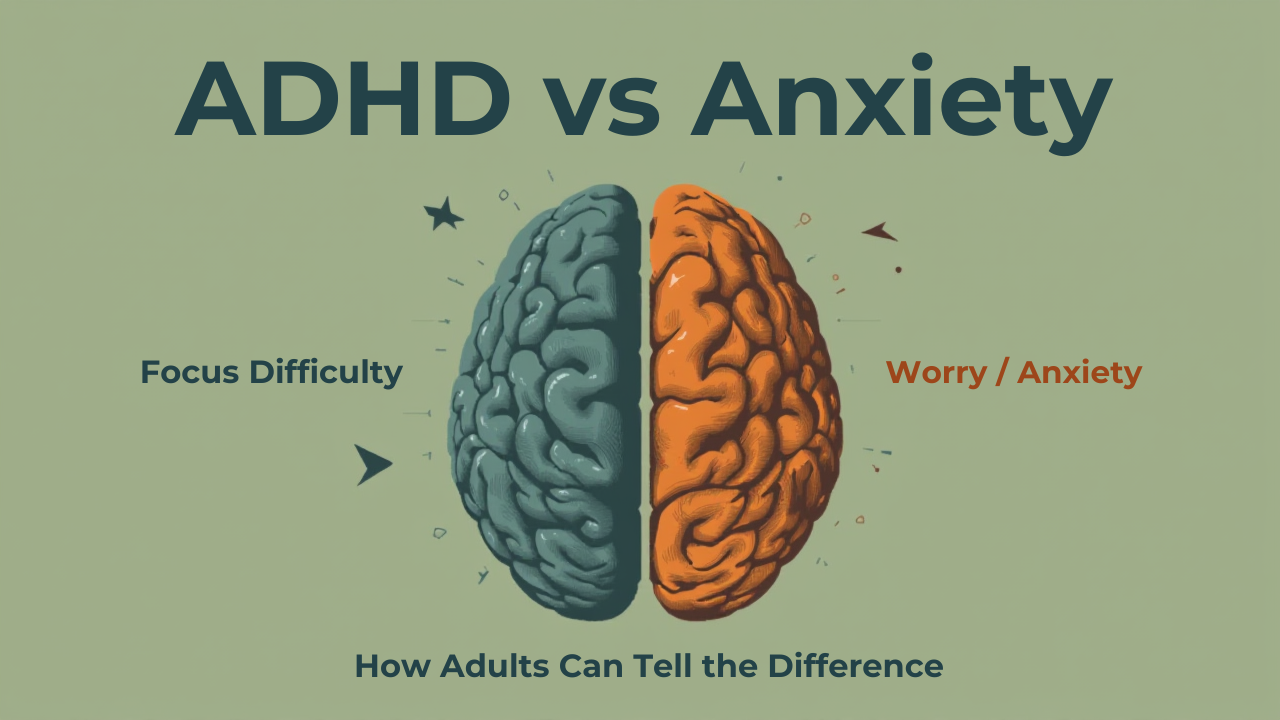
Many adults struggle with focus, racing thoughts, and overwhelm and assume anxiety is the cause. However, ADHD and anxiety often overlap. Learn how clinicians distinguish ADHD from anxiety and when adults in Pennsylvania and Delaware may benefit from ADHD testing.
Many adults who struggle with focus, racing thoughts, or difficulty completing tasks assume they may have anxiety.
However, symptoms of ADHD and anxiety often overlap, which can make it difficult to determine the underlying cause.
Understanding the difference can help individuals decide whether an ADHD evaluation for adults may be helpful.
Why ADHD and Anxiety Are Often Confused
Both conditions can involve:
• difficulty concentrating
• restlessness
• racing thoughts
• feeling overwhelmed
• trouble completing tasks
Many adults first begin exploring these questions when they recognize signs of ADHD in adults that have affected them for years.
Key Differences Between ADHD and Anxiety
ADHD
ADHD primarily affects attention regulation and executive functioning.
Common patterns include:
• difficulty starting tasks
• losing items frequently
• procrastination
• time blindness
• impulsive decisions
These symptoms often occur even when a person feels calm.
Anxiety
Anxiety is primarily related to excessive worry or fear about future events.
Common patterns include:
• persistent worry
• physical tension
• difficulty relaxing
• fear of making mistakes
• overthinking decisions
Concentration problems usually occur because the mind is preoccupied with worry.
When ADHD and Anxiety Occur Together
Many adults experience both ADHD and anxiety.
In fact, untreated ADHD can lead to anxiety because individuals may struggle with:
• missed deadlines
• disorganization
• difficulty keeping up with responsibilities
Over time, this stress can increase anxiety symptoms.
When ADHD is identified and treated, many adults experience improvement in both focus and anxiety symptoms, especially when appropriate ADHD medications for adults are considered.
How ADHD Evaluations Help Clarify the Diagnosis
An ADHD evaluation typically includes:
• review of symptom history
• discussion of attention patterns
• evaluation of executive functioning
• screening for anxiety and other conditions
This process helps determine whether ADHD, anxiety, or a combination of factors may be affecting daily functioning.
ADHD Testing and Treatment for Adults
Adults located in Pennsylvania or Delaware who experience persistent focus difficulties may benefit from a professional ADHD evaluation for adults in Pennsylvania and Delaware.
ADHDPhiladelphia.com provides adult ADHD testing and treatment through telehealth and follow-up care.
Understanding the cause of attention challenges can help individuals develop effective strategies for improving focus, productivity, and quality of life.
How ADHD Testing Works for Adults in Pennsylvania and Delaware
Many adults wonder how ADHD testing works and what happens during an ADHD evaluation. This guide explains the ADHD assessment process and how adults in Pennsylvania and Delaware can seek testing and treatment.
Many adults struggle with focus, procrastination, organization, or time management for years before considering whether ADHD may be contributing to these challenges. Learning more about adult ADHD testing and treatment can help individuals understand whether an evaluation may be helpful.
One of the most common questions people ask is:
“How does ADHD testing work for adults?”
Understanding the evaluation process can help individuals decide whether seeking an assessment may be helpful.
Many adults first begin exploring these questions when reading about signs of ADHD in adults.
Many adults pursue an ADHD evaluation after years of believing their difficulties were related to anxiety or stress. Because the symptoms of ADHD and anxiety often overlap, it can be difficult to distinguish between the two without a professional evaluation. Our guide on the difference between ADHD and anxiety in adults explains the key signs clinicians look for.
Why Adults Seek ADHD Testing
Many adults begin exploring ADHD testing after recognizing patterns such as:
difficulty sustaining attention
chronic procrastination
disorganization
losing important items
difficulty finishing tasks
trouble managing time
While these experiences can occur for many reasons, persistent patterns may suggest that an ADHD evaluation for adults could be helpful.
What Happens During an Adult ADHD Evaluation
An ADHD evaluation typically involves several important steps designed to understand how attention and executive functioning affect daily life.
1. Clinical Interview
The evaluation begins with a detailed discussion about symptoms, history, and daily functioning.
Clinicians often review:
attention difficulties
work or academic challenges
organizational patterns
impulsivity or restlessness
The clinician may also explore childhood experiences, since ADHD symptoms typically begin earlier in life even if diagnosis occurs later.
2. Symptom Assessment
Structured screening tools and symptom checklists may be used to evaluate common ADHD patterns such as:
inattention
hyperactivity or restlessness
impulsivity
executive functioning challenges
These tools help clinicians understand how symptoms affect work, school, and daily responsibilities.
3. Review of Daily Functioning
A key part of ADHD diagnosis is determining whether symptoms cause meaningful impairment in daily life.
This may include discussion of:
workplace performance
academic responsibilities
organization and time management
relationships and communication
4. Screening for Other Conditions
Because symptoms like difficulty concentrating can also occur in other conditions, clinicians often evaluate for factors such as:
anxiety
depression
sleep issues
stress
This helps ensure the most accurate understanding of what may be affecting attention and focus.
Because ADHD and anxiety share overlapping symptoms such as difficulty concentrating and feeling overwhelmed, a professional evaluation can help clarify the cause. Learn more about how ADHD and anxiety differ in adults in our detailed guide.
Can ADHD Testing Be Done Through Telehealth?
Many adults now complete ADHD evaluations through telehealth appointments.
Telehealth allows clinicians to conduct detailed interviews, review symptom history, and assess functioning while patients remain in their own environment.
For many adults, this makes the evaluation process more convenient and accessible.
What Happens After an ADHD Diagnosis?
If ADHD is diagnosed, treatment options may include:
medication management
behavioral strategies
executive functioning support
lifestyle adjustments
Treatment plans are individualized based on each person’s needs and goals.
Adults often explore options such as ADHD medication treatment for adults.
ADHD Testing for Adults in Pennsylvania and Delaware
Adults located in Pennsylvania or Delaware who experience persistent focus difficulties may benefit from a professional ADHD evaluation for adults in Pennsylvania and Delaware.
ADHDPhiladelphia.com provides adult ADHD testing and treatment through telehealth and follow-up care.
Understanding how ADHD affects attention and executive functioning can help individuals develop strategies to improve productivity, focus, and overall quality of life.
FAQ
Frequently Asked Questions About Adult ADHD Testing
How long does ADHD testing take for adults?
The evaluation process may involve a clinical interview, symptom assessment, and review of daily functioning.
Can adults be diagnosed with ADHD later in life?
Yes. Many adults receive an ADHD diagnosis after recognizing long-standing patterns of attention and executive functioning challenges.
Do adults need testing to receive ADHD treatment?
A professional evaluation helps clinicians determine whether ADHD or another condition may be affecting attention and focus.

Do I Have ADHD? 15 Signs Adults Should Not Ignore
Many adults live for years with symptoms of ADHD without realizing it. Learn 15 signs of ADHD in adults and how a professional evaluation can help you understand your focus, productivity, and mental health.
Many adults struggle with focus, organization, and productivity for years before realizing that ADHD may be the underlying cause. If these challenges sound familiar, learning more about adult ADHD testing and treatment may be an important first step.
Attention-Deficit/Hyperactivity Disorder (ADHD) is a neurodevelopmental condition that affects attention regulation, executive functioning, and impulse control. Although it is often associated with children, ADHD frequently continues into adulthood and may remain undiagnosed for many years.
Many adults describe feeling capable and intelligent, yet frustrated by their difficulty staying organized, completing tasks, or maintaining focus.
Many people experience several of these patterns without realizing they may reflect signs of undiagnosed ADHD in adults.
How to Tell if You Might Have ADHD as an Adult
Many adults wonder whether their difficulties with focus, organization, procrastination, or time management could be related to ADHD.
Common signs of ADHD in adults include difficulty starting tasks, losing important items, becoming easily distracted, trouble finishing projects, and feeling mentally restless.
While reading about symptoms can be helpful, ADHD can only be diagnosed through a professional evaluation that reviews symptom history, daily functioning, and other factors that may affect attention.
Adults experiencing these challenges may benefit from learning more about adult ADHD testing and treatment.
15 Signs Adults May Have ADHD
1. Chronic Procrastination
You often delay starting important tasks even when you know they are important.
2. Difficulty Starting Projects
Beginning tasks can feel overwhelming, even when the task itself is not complicated.
3. Trouble Finishing What You Start
Many adults with ADHD start projects with enthusiasm but struggle to complete them.
4. Losing Important Items
Keys, phones, wallets, and documents frequently go missing.
5. Forgetting Appointments or Deadlines
Even when you use calendars or reminders, it may still be difficult to keep track of commitments.
6. Disorganization
Your workspace, home, or digital files may feel constantly cluttered or difficult to manage.
7. Difficulty Managing Time
Many adults with ADHD experience “time blindness,” where tasks take much longer than expected.
8. Trouble Paying Attention During Conversations
You may unintentionally drift off during conversations, meetings, or lectures.
9. Feeling Mentally Restless
Even when sitting still, your mind may feel constantly active or racing.
10. Impulsive Decisions
You may make quick decisions without fully thinking through the consequences.
11. Difficulty Prioritizing Tasks
Knowing what to do first can feel overwhelming when multiple responsibilities compete for attention.
12. Becoming Easily Distracted
Small interruptions or background noise may quickly break your concentration.
13. Difficulty Completing Routine Tasks
Administrative tasks, paperwork, or repetitive work can feel particularly challenging.
14. Emotional Frustration With Productivity
Many adults with ADHD feel frustrated because they know they are capable of more.
15. Feeling Overwhelmed by Daily Responsibilities
Managing work, personal tasks, and responsibilities may feel exhausting.
Why ADHD Is Often Missed in Adults
Many adults grow up without being diagnosed because symptoms may be misunderstood as:
laziness
stress
anxiety
lack of motivation
However, ADHD is a neurological condition affecting how the brain regulates attention and executive functioning.
Because symptoms can overlap with anxiety, depression, and stress, many adults are diagnosed later in life after years of frustration. Many people also wonder about the differences between ADHD vs anxiety when trying to understand their symptoms.
When to Consider an ADHD Evaluation
If symptoms like these interfere with your work, relationships, or daily responsibilities, a professional evaluation may help clarify whether ADHD is contributing to these challenges. You can also learn more about how ADHD testing works for adults.
An ADHD evaluation typically includes:
review of symptom history
discussion of current functioning
screening for other conditions
clinical assessment of attention and executive function
ADHD Testing and Treatment for Adults
Adults located in Pennsylvania or Delaware who are experiencing persistent focus difficulties may benefit from a professional ADHD evaluation for adults in Pennsylvania and Delaware.
ADHDPhiladelphia.com provides adult ADHD testing and treatment through telehealth and follow-up care.
Understanding whether ADHD is present can help individuals develop effective strategies for improving focus, productivity, and overall quality of life.
Quick Self-Reflection: Do These ADHD Patterns Sound Familiar?
Many adults begin exploring ADHD after recognizing patterns in their daily lives. While reading about symptoms can be helpful, it is important to remember that only a qualified clinician can diagnose ADHD.
Consider whether several of the following experiences feel familiar:
Difficulty starting tasks even when they are important
Frequently losing or misplacing everyday items
Trouble finishing projects or assignments
Feeling overwhelmed by organization or time management
Struggling to stay focused during conversations or meetings
Forgetting appointments or deadlines
Feeling mentally restless even when trying to relax
Becoming easily distracted by small interruptions
If multiple patterns like these occur consistently and interfere with work, school, or daily responsibilities, it may be helpful to learn more about adult ADHD testing and treatment.
A professional evaluation can determine whether ADHD or another condition may be contributing to these challenges.
If you are wondering whether ADHD may be affecting your focus, organization, or productivity, learning more about adult ADHD testing and treatment may help clarify the next steps.
Many adults are surprised to learn that ADHD can continue into adulthood. Recognizing patterns like procrastination, difficulty focusing, and time management challenges can help people better understand their experiences and decide whether an ADHD evaluation may be helpful.
Frequently Asked Questions About Adult ADHD
Can ADHD go undiagnosed in adults?
Yes. Many adults are diagnosed later in life because symptoms may be mistaken for stress, anxiety, or personality traits.
How do adults know if they might have ADHD?
Common signs include difficulty focusing, procrastination, disorganization, losing items, and struggling with time management.
How do adults get tested for ADHD?
An ADHD evaluation typically involves reviewing symptom history, current functioning, and screening for other conditions that may affect attention.
Can ADHD testing be done through telehealth?
Yes. Many adults complete ADHD evaluations through telehealth appointments with qualified providers.
Stimulant vs Non-Stimulant ADHD Medications: What Adults Should Know
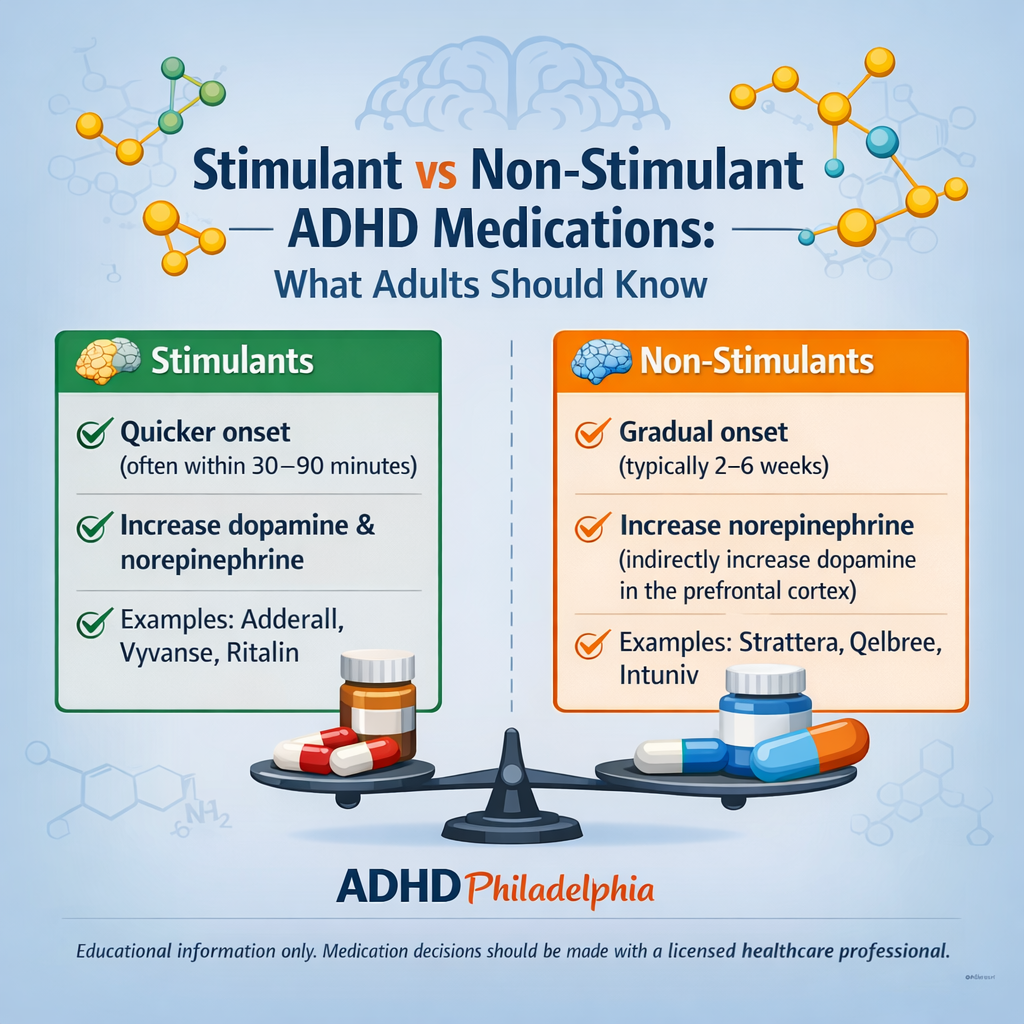
Stimulant and non-stimulant ADHD medications work differently in the brain. Learn how each option helps adults improve focus and executive function.
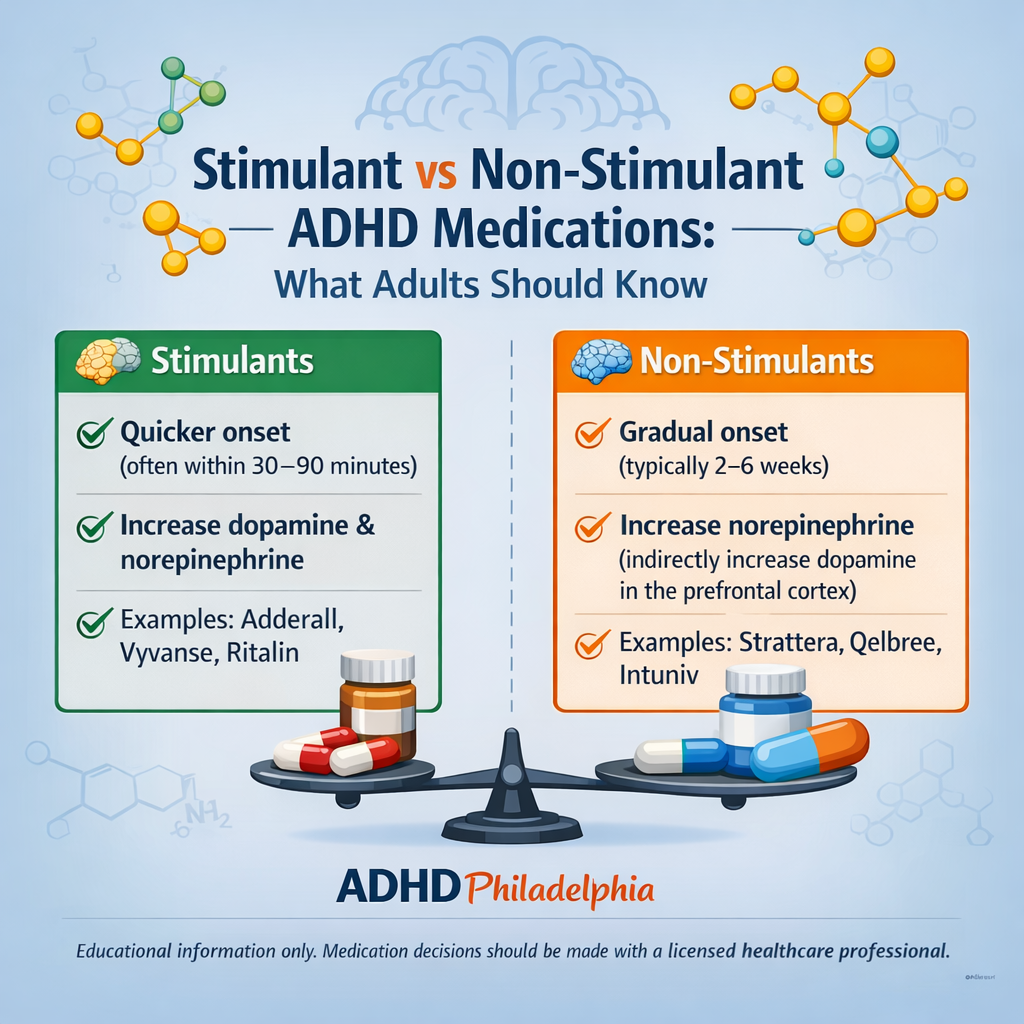
Many adults living with ADHD eventually ask the same question:
“What medication is best for ADHD — stimulants or non-stimulants?”
Understanding the difference can help patients feel more informed and confident about treatment decisions.
At ADHDPhiladelphia.com, we work with adults across Pennsylvania and Delaware who are seeking clear information about ADHD medications and how they affect the brain.
The goal is always the same: help the brain regulate focus, motivation, and executive function more effectively.
Some adults seek treatment for anxiety before realizing their symptoms may actually be related to ADHD. Because the two conditions can overlap, it’s important to understand the difference. Our article on ADHD vs anxiety in adults explains how clinicians distinguish between these conditions.
How ADHD Affects the Brain
ADHD is a neurodevelopmental condition that affects how the brain regulates attention, organization, and impulse control.
The brain regions most involved include:
• Prefrontal cortex
• Anterior cingulate cortex
• Dopamine reward pathways
• Norepinephrine attention systems
These systems help regulate:
• focus
• motivation
• working memory
• task completion
• emotional regulation
When these systems are underactive or dysregulated, everyday tasks can feel significantly harder than they should.
Medication is one of the tools that can help restore more balanced signaling in these networks.
What Are Stimulant ADHD Medications?
Stimulant medications are the most commonly prescribed treatment for ADHD.
They work by increasing the availability of dopamine and norepinephrine, two neurotransmitters that help regulate attention and motivation.
Common stimulant medications include:
• Adderall (amphetamine salts)
• Vyvanse (lisdexamfetamine)
• Ritalin (methylphenidate)
• Concerta (extended-release methylphenidate)
These medications help improve:
• sustained focus
• mental clarity
• task initiation
• impulse control
For many adults, stimulants work quickly and effectively and are often considered first-line treatment.
What Are Non-Stimulant ADHD Medications?
Non-stimulant medications are another option for treating ADHD.
They typically work more gradually by affecting norepinephrine signaling or other regulatory systems in the brain.
Examples include:
• Atomoxetine (Strattera)
• Guanfacine (Intuniv)
• Clonidine
• Certain antidepressants used off-label
Non-stimulants may be recommended when:
• stimulants cause side effects
• there is a medical reason stimulants are not appropriate
• patients prefer a non-stimulant option
• there is concern about misuse or dependence
These medications often take several weeks to reach full effectiveness.
How Doctors Decide Which Medication Is Best
Choosing the right ADHD medication is a personalized process.
Clinicians typically consider:
• symptom severity
• previous medication history
• sleep patterns
• anxiety or mood symptoms
• work demands
• medical history
The goal is to find a treatment plan that helps the brain function better while minimizing side effects.
ADHD Treatment Is More Than Medication
Medication can be a powerful tool, but it works best alongside other strategies:
• structured routines
• sleep optimization
• exercise
• ADHD coaching
• therapy when needed
Many adults experience meaningful improvement when treatment is individualized and monitored carefully.
ADHD Testing and Treatment in Pennsylvania and Delaware
If you’re an adult struggling with focus, procrastination, or mental overload, an ADHD evaluation may help provide answers.
At ADHDPhiladelphia.com, we provide:
✔ Adult ADHD evaluations
✔ Medication management
✔ Telehealth appointments across Pennsylvania and Delaware
✔ Ongoing treatment monitoring
Many adults discover that ADHD has been affecting their work, education, and daily life for years without realizing it.
The good news is that effective treatments are available.
Schedule an ADHD Evaluation
Learn more or schedule an appointment at:
https://www.ADHDPhiladelphia.com
—
Charles T
Psychiatric Nurse Practitioner
Adult ADHD Specialist

Why Adults With ADHD Struggle With Focus — and How Treatment Helps the Brain Work Better
Adults with ADHD often struggle with focus, organization, and motivation. Learn how ADHD affects the brain and how professional testing and treatment in Philadelphia and Delaware can help improve attention and daily functioning.
Why Adults With ADHD Struggle With Focus — and How Treatment Helps the Brain Work Better
Many adults believe their difficulty focusing is simply a matter of discipline or motivation. They may blame themselves for procrastination, unfinished projects, or feeling overwhelmed by tasks that seem easy for others.
However, for millions of adults, these struggles are not a character flaw. They are often symptoms of Attention-Deficit/Hyperactivity Disorder (ADHD) — a neurodevelopmental condition that affects how the brain regulates attention, motivation, and executive functioning.
Understanding what is happening in the brain can help people realize that effective treatment is available and that improvement is possible.
ADHD Is a Brain Regulation Condition
ADHD affects the brain systems responsible for executive functioning, which includes:
Sustaining attention
Organizing tasks
Managing time
Prioritizing responsibilities
Regulating impulses
Maintaining motivation
These skills rely heavily on activity in the prefrontal cortex, a region of the brain responsible for planning, decision-making, and attention regulation.
Research shows that people with ADHD often experience differences in dopamine and norepinephrine signaling within these brain networks, which can make it more difficult to maintain consistent attention and motivation.
This means a person with ADHD can focus, but often struggles to do so when they need to, for as long as they need to, or on tasks that are not immediately rewarding. manual-executive-function-adhd-…
Common Signs of Undiagnosed Adult ADHD
Many adults do not realize their symptoms may be related to ADHD. Some of the most common experiences include:
• Difficulty finishing projects
• Losing focus during conversations
• Forgetting appointments or deadlines
• Feeling overwhelmed by organization tasks
• Procrastinating even on important responsibilities
• Struggling with time management
• Frequently switching between tasks without completing them
Because ADHD often persists from childhood into adulthood, many people have lived with these challenges for years without realizing there may be an underlying explanation.
Why ADHD Often Goes Undiagnosed in Adults
Adult ADHD is commonly overlooked for several reasons:
1️⃣ Symptoms may have been misunderstood during childhood
2️⃣ Adults develop coping strategies that mask symptoms
3️⃣ Many people assume ADHD only affects children
4️⃣ Symptoms overlap with stress, anxiety, or depression
As a result, adults may struggle silently while assuming their challenges are simply part of their personality.
The Good News: ADHD Is Treatable
The encouraging reality is that ADHD is one of the most treatable conditions in mental health.
Treatment may include:
Evidence-based medication options
Behavioral strategies
Executive function skill development
Structured routines and planning systems
Stimulant and non-stimulant medications are among the most researched and effective treatments available for ADHD when prescribed and monitored appropriately. manual-advances-management-adhd
Many adults experience significant improvement in focus, productivity, and overall quality of life once treatment begins.
ADHD Testing and Treatment in Pennsylvania and Delaware
At ADHDPhiladelphia.com, we specialize in evaluating and treating adult ADHD through a structured, professional process designed to help individuals better understand their symptoms and develop an effective treatment plan.
Services include:
Adult ADHD evaluation
Medication management when appropriate
Ongoing monitoring and follow-up care
Personalized treatment planning
Appointments begin through secure telehealth, allowing patients to receive care from the comfort of home.
When appropriate, in-person appointments may be scheduled after the initial telehealth visit.
When to Consider ADHD Testing
You may want to consider an evaluation if you regularly experience:
• Persistent difficulty focusing
• Chronic procrastination
• Trouble organizing tasks
• Problems finishing projects
• Frequent mental overwhelm
• Difficulty managing responsibilities
Seeking professional evaluation can provide clarity and help determine whether ADHD may be contributing to these challenges.
Moving Forward
If you believe ADHD may be affecting your focus or daily functioning, professional evaluation can provide answers and help guide effective treatment options.
You can learn more about testing and treatment options at:

Why Smart Adults Often Miss an ADHD Diagnosis (And What To Do About It)
High-functioning adults often compensate for ADHD symptoms until stress and burnout increase. Learn how intelligence can mask executive dysfunction and why a structured ADHD evaluation in Pennsylvania and Delaware matters.
Many high-achieving adults are surprised to learn they have ADHD.
They finished college.
They built careers.
They manage responsibilities.
So how could ADHD have been missed?
The answer is simple: intelligence can compensate — until it can’t.
For many adults in Pennsylvania and Delaware, ADHD isn’t obvious in childhood. Instead, it becomes more visible when life demands exceed coping strategies.
Why ADHD Is Often Overlooked in Smart Adults
ADHD is not a measure of intelligence.
In fact, many adults with ADHD are:
• Creative
• Verbally strong
• High-performing under pressure
• Capable of last-minute success
Strong cognitive ability can mask executive dysfunction for years.
Deadlines get met — but through stress.
Assignments get completed — but at the last minute.
Work gets done — but at personal cost.
Eventually, the compensatory strategies stop working.
What Changes in Adulthood?
As responsibilities increase, ADHD symptoms become harder to hide.
Adults may begin noticing:
• Chronic procrastination
• Decision fatigue
• Difficulty initiating tasks
• Inconsistent productivity
• Emotional overwhelm
• Burnout despite effort
At this stage, many are misdiagnosed with anxiety, depression, or simple stress.
A structured adult ADHD evaluation helps clarify the difference.
You can learn more about our adult ADHD evaluation process here.
The Hidden Cost of Compensation
When ADHD is undiagnosed, adults often internalize the struggle.
They may think:
“I’m lazy.”
“I’m not disciplined.”
“I should be doing better.”
Over time, chronic stress can impact sleep, emotional regulation, and overall health.
Research suggests untreated ADHD may contribute to long-term risk patterns related to impulsivity and lifestyle instability.
You can read more about how undiagnosed ADHD may impact long-term health here.
Why Proper Diagnosis Matters
A comprehensive ADHD evaluation includes:
• Structured clinical interview
• Functional impairment assessment
• Review of childhood history
• Screening for overlapping conditions
• When appropriate, ADHD testing
Diagnosis is not based on intelligence.
It is based on persistent patterns of executive dysfunction and impairment.
If ADHD is diagnosed, structured treatment options are reviewed.
Learn more about our ADHD treatment and medication management approach.
What To Do If This Sounds Familiar
If you are a high-functioning adult who has always “managed” but never felt stable, it may be worth exploring whether ADHD is part of the picture.
Clarity is not about labeling.
It is about understanding how your brain works — and building sustainable systems around it.
Adult ADHD Care in Pennsylvania & Delaware
At ADHD Philadelphia, we specialize exclusively in adult ADHD diagnosis and structured treatment.
Telehealth appointments are available throughout Pennsylvania and Delaware.
In-person appointments may be scheduled after the initial evaluation when clinically appropriate.
There are no walk-in appointments.
Ready to Take the Next Step?
If you suspect ADHD may have been overlooked, a structured evaluation can provide clarity.

How Do You Know If ADHD Medication Is Working in Adults?
Learn how to tell if ADHD medication is working in adults. Discover what improvement should look like, when adjustments are needed, and how structured monitoring supports safe ADHD treatment in Pennsylvania and Delaware.
One of the most common questions adults ask after starting ADHD medication is:
“Is this actually working?”
For adults diagnosed with ADHD, improvement is not always dramatic. It is often subtle — but clinically meaningful.
Understanding what improvement should look like helps ensure treatment remains safe, appropriate, and effective.
If you are unsure how adult ADHD is diagnosed, you can learn more about our comprehensive evaluation process here.
What Improvement Should Look Like
When medication is properly matched and monitored, adults often notice:
• Improved task initiation
• Reduced procrastination
• Increased sustained attention
• Better organization
• Fewer careless mistakes
• Improved emotional regulation
It may not feel like a “burst of motivation.”
Instead, it often feels like:
“It’s easier to start.”
What Medication Should NOT Do
Medication should not:
• Make you feel euphoric
• Cause severe anxiety
• Dramatically alter personality
• Eliminate normal fatigue
• Replace healthy habits
If side effects outweigh benefits, adjustments are needed.
How Long Does It Take?
Stimulants may begin working the same day.
Non-stimulants may take several weeks.
However, effectiveness must be evaluated over time.
That’s why structured 30-day monitoring is important.
Medication effectiveness should always be evaluated in the context of overall functioning, medical history, and safety considerations.
👉 Learn more about our Medication Management & Stimulant Treatment Policy.
Measuring Functional Improvement
Medication success is measured by:
• Workplace performance
• Academic productivity
• Household task completion
• Time management
• Emotional stability
It is not measured by “feeling different.”
It is measured by functioning better.
When Adjustments Are Needed
You may need adjustment if:
• Benefits are inconsistent
• Focus improves but anxiety worsens
• Sleep becomes disrupted
• Blood pressure increases
• Motivation improves but organization does not
Medication is one tool — not the entire solution.
Comprehensive ADHD treatment often includes behavioral strategies, executive functioning support, and lifestyle optimization alongside medication management.
ADHD Treatment in Pennsylvania & Delaware
At ADHD Philadelphia, medication effectiveness is evaluated through structured follow-up and symptom review.
Treatment decisions are individualized and may include stimulant or non-stimulant options depending on clinical presentation.
You can also read our detailed comparison of stimulant vs non-stimulant ADHD medications here.
Telehealth available throughout Pennsylvania & Delaware.
In-person appointments may be scheduled after the initial visit.
We serve adults in Philadelphia, Montgomery County, Bucks County, Chester County, Wilmington, Newark, Dover, and surrounding communities.
Ready to Begin?
If you are an adult located in Pennsylvania or Delaware and unsure whether ADHD medication may be appropriate, schedule a comprehensive evaluation to review your symptoms, medical history, and treatment options.

ADHD vs Anxiety in Adults: How to Tell the Difference in Pennsylvania and Delaware
Many adults come to evaluation asking:
“Is this ADHD… or is it anxiety?”
The truth is — they can look similar.
Both can cause:
Difficulty concentrating
Restlessness
Sleep problems
Racing thoughts
Irritability
But they are not the same condition.
Understanding the difference matters. Treatment plans are very different.
The Core Difference: Regulation vs Worry
ADHD is primarily a disorder of executive function and self-regulation.
Anxiety is primarily a disorder of excessive fear and anticipatory worry.
In ADHD:
The mind jumps because it is under-regulated.
Focus drops when interest drops.
Time management collapses under low stimulation.
In anxiety:
Focus drops because worry consumes cognitive bandwidth.
Thoughts loop around fear-based themes.
Avoidance behaviors increase.
How ADHD Presents in Adults
Adult ADHD often includes:
Chronic procrastination
Time blindness
Difficulty starting tasks
Forgetfulness
Losing items
Interrupting conversations
Emotional impulsivity
These patterns are lifelong — even if they were masked in childhood.
If you haven’t read it yet, see:
👉 What Happens During an Adult ADHD Evaluation?
👉 How Long Does an Adult ADHD Evaluation Take?
How Anxiety Presents in Adults
Anxiety more often includes:
Excessive worry about worst-case outcomes
Physical tension
Panic episodes
Catastrophic thinking
Avoidance of feared situations
Sleep disruption due to rumination
The driver is fear — not executive dysfunction.
When ADHD and Anxiety Overlap
Many adults have both.
Chronic executive dysfunction can create secondary anxiety.
Missing deadlines repeatedly can create fear of failure.
This is why rushed diagnoses are risky.
A thorough ADHD evaluation includes differential diagnosis screening to ensure accuracy.
If you’ve ever wondered whether your symptoms are related to attention difficulties or worry-driven thinking patterns, our article on the difference between ADHD and anxiety in adults explains the key signs to look for.
Why Accurate Diagnosis Matters
Treating anxiety as ADHD may leave core fear untreated.
Treating ADHD as anxiety may leave executive dysfunction untreated.
Medication decisions differ.
Therapy approaches differ.
Behavioral systems differ.
If you're in Pennsylvania or Delaware and unsure which condition applies, a structured evaluation can clarify the difference.
Serving Adults in PA & DE
At ADHDPhiladelphia.com, adult evaluations are:
DSM-aligned
Executive-function informed
Differential-diagnosis focused
Designed to reduce misdiagnosis
Telehealth is available throughout Pennsylvania and Delaware.
In-person appointments are available after the initial telehealth visit. No walk-ins.
If you’ve been wondering whether your concentration difficulties are ADHD or anxiety, the next step is a careful evaluation.
👉Book your consultation today.

What Happens During an Adult ADHD Evaluation? A Step-by-Step Breakdown
What actually happens during an adult ADHD evaluation? This step-by-step breakdown explains the diagnostic process, DSM criteria review, executive function assessment, and rule-outs used for accurate ADHD diagnosis in Pennsylvania and Delaware.
What Happens During an Adult ADHD Evaluation? A Step-by-Step Breakdown
If you’ve been wondering whether you might have ADHD, one of the biggest questions is:
“What actually happens during an adult ADHD evaluation?”
A proper evaluation is not a quick checklist. It is a structured, evidence-based process designed to ensure diagnostic accuracy and protect you from misdiagnosis.
Here is what a comprehensive adult ADHD evaluation typically includes in Pennsylvania and Delaware.
Step 1: Clinical Interview and Developmental History
ADHD is classified as a neurodevelopmental disorder, meaning symptoms begin in childhood — even if they were never diagnosed.
A thorough evaluation includes:
Early academic performance
Childhood behavior patterns
Reported distractibility or impulsivity
Family history of ADHD
Occupational history
Relationship patterns
Current functional impairment
Many high-functioning adults masked symptoms for years. The evaluation explores patterns — not isolated bad days.
Step 2: DSM-5-TR Criteria Review
Diagnosis is aligned with the DSM-5-TR diagnostic criteria.
This includes:
Number of inattentive and/or hyperactive-impulsive symptoms
Evidence of symptoms before age 12
Impairment across two or more settings
Clear evidence of functional impact
Diagnosis is not based on feeling overwhelmed.
It is based on consistent patterns of executive dysfunction and impairment.
Step 3: Executive Function Assessment
ADHD is fundamentally a disorder of self-regulation.
We evaluate patterns in:
Task initiation
Time management
Working memory
Organization
Follow-through
Emotional regulation
Sustained attention during low-interest tasks
ADHD is not a knowledge problem.
It is a performance regulation problem.
Step 4: Differential Diagnosis (Rule-Out Process)
This is one of the most important steps.
Many conditions can mimic ADHD symptoms:
Anxiety disorders
Depression
Trauma-related conditions
Sleep disorders
Thyroid issues
Burnout
Substance use
A rushed evaluation increases the risk of misdiagnosis.
A careful evaluation protects you.
Step 5: Structured Screening Tools (When Appropriate)
Standardized symptom measures may be used to:
Assess severity
Compare patterns
Document baseline functioning
Track improvement over time
These tools support — but do not replace — clinical judgment.
Step 6: Treatment Planning Discussion
If ADHD is diagnosed, the next conversation includes:
Medication options (stimulant vs non-stimulant)
Behavioral systems and structure
Executive skill supports
Workplace or academic accommodations
Follow-up frequency
Medication is not the entire plan.
Executive systems matter.
How Long Does This Process Take?
If you missed Part 1 of this series, read:
How Long Does an Adult ADHD Evaluation Take in Pennsylvania or Delaware?
The short answer: long enough to get it right.
Serving Adults in Pennsylvania and Delaware
At ADHDPhiladelphia.com, adult ADHD evaluations are:
Evidence-based
Structured
DSM-aligned
Executive-function informed
Designed to reduce misdiagnosis
Telehealth appointments are available across Pennsylvania and Delaware.
In-person appointments are available after the first telehealth visit. No walk-ins.
If you’ve been wondering whether ADHD explains long-standing patterns in your life, the first step is a thorough evaluation.
👉Book your initial consultation today.
If you’re wondering how long the process takes, read How Long Does an Adult ADHD Evaluation Take?

How Long Does an Adult ADHD Evaluation Take in Pennsylvania or Delaware?
Learn how long an adult ADHD evaluation takes in Pennsylvania and Delaware. Understand the structured 2-step process, $150 per appointment pricing, and what to expect from diagnosis through treatment planning.
If you are considering an adult ADHD evaluation, one of the most common questions is:
“How long does the process take?”
The answer depends on structure — not guesswork.
At ADHD Philadelphia, adult ADHD evaluations follow a clear, step-by-step process designed to provide diagnostic clarity without unnecessary delays.
Step 1: ADHD Consultation — $150
The evaluation begins with a structured clinical consultation conducted via secure telehealth for adults residing in Pennsylvania and Delaware.
During this appointment, we review:
• Childhood symptom history
• Current attention and executive functioning patterns
• Functional impairment at work, school, or home
• Emotional regulation patterns
• Medical and psychiatric history
This appointment typically lasts 45–60 minutes.
Structured interview is the foundation of accurate diagnosis.
If you want a deeper explanation of diagnostic criteria, visit our Adult ADHD Diagnosis page.
Step 2: ADHD Testing — $150
When clinically appropriate, computerized ADHD testing and behavioral questionnaires are completed following the consultation.
Testing provides objective data to support diagnostic clarity.
Some adults may not require computerized testing if the clinical picture is clear.
Testing results are reviewed in a follow-up discussion where treatment planning begins.
For a detailed explanation of how testing fits into the evaluation process, visit our ADHD Testing & Evaluation page.
How Many Appointments Are Required?
For most adults:
• Consultation (Appointment 1)
• Testing + Results Review (Appointment 2)
Together, these make up the full structured evaluation.
Total cost: $300
Each appointment: $150
When Can Treatment Begin?
If ADHD is diagnosed, treatment options are discussed after evaluation is complete.
Medication is never prescribed without diagnostic clarity.
If medication is part of the treatment plan:
• Stimulants require monthly follow-up appointments
• Non-stimulants typically require follow-up every 30–90 days
All ongoing medication management visits are $150 per appointment.
For more details on treatment structure, visit our ADHD Treatment & Medication Management page.
Can the Evaluation Be Done Quickly?
Many adults appreciate that the process is structured and efficient.
Because initial appointments are conducted via secure telehealth:
• Scheduling is often faster
• Same-day availability may exist
• Travel time is eliminated
In-person visits may be scheduled afterward when clinically appropriate.
There are no walk-in appointments.
Why Structured Evaluation Matters
Online ADHD quizzes may feel quick — but they are not diagnostic.
Accurate adult ADHD diagnosis requires:
• Clinical interview
• Functional impairment assessment
• Screening for overlapping conditions
• Professional medical judgment
Speed should never replace accuracy.
Untreated ADHD can impact more than productivity — it may affect long-term health through stress, risk patterns, and lifestyle instability. Read more about the connection between undiagnosed ADHD and longevity.
The Bottom Line
An adult ADHD evaluation is not a months-long process — but it is structured.
For most adults, diagnostic clarity is achieved in two appointments.
If you are searching for:
• ADHD evaluation near me
• ADHD diagnosis Pennsylvania
• ADHD testing Delaware
• ADHD assessment for adults
Clarity begins with structured evaluation.